

Documentation
Description
What is it, and what it does
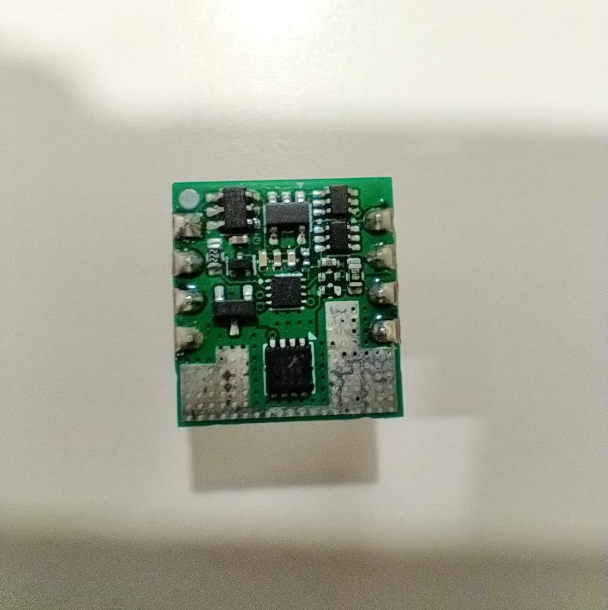
The IS4413 is a module that generates a 4–20 mA current loop signal (3-wire configuration), controlled via I2C-serial interface from your microcontroller.
Utility
The module allows you to design process control systems such as sensors or transmitters that send process control data to a PLC, or to design actuator controllers.
For example, you may design a custom sensor that needs to report data via 4–20 mA; the module can be used to send the current. Or you may need to control a current loop actuator without implementing a PLC system, in which case the module can be used.
Benefits
The module saves all the time required to engineer the analog circuitry of a current loop transmitter, allowing you to finish your product sooner.
The product integrates very easily through the standard I2C-serial interface, which is present in any microcontroller or microprocessor. The product does not require specific libraries; only one register is needed to control the output current.
Configurable Safe Power-Up Current
The module incorporates a safe power-up system, which allows you to set the current that will be generated before any I2C command is received. This is especially useful to prevent the module from sending an invalid current during the few milliseconds before the microcontroller has completely initialized and sent the I2C command that configures the current. This safe power-up current can be set to 0 mA, which will be interpreted by the current loop receiver as invalid data and therefore discarded.
The safe power-up current is saved in the internal EEPROM by issuing the Set Default Value command (writing value 96 to the Command register) instead of Set Current Value (writing value 64 to the Command register).
Self-Power Higher Than 4 mA
3-wire current loop transmitters have a major benefit over 2-wire transmitters: the amount of current the transmitter can draw to power itself.
2-wire current loop transmitters can be self-powered, but they cannot use more than 4 mA, as they use the same loop for power and for the current loop value; if they used more than 4 mA they would generate a wrong 4–20 mA reading. This makes 2-wire current loop transmitters suitable only for very simple sensors.
On the other hand, 3-wire current loop transmitters have the power and the current loop value split independently into two circuits, making the self-powered consumption independent from the generated current loop. This allows the transmitter to consume more than 4 mA and therefore allows much more complex self-powered current loop transmitters to be built.
Extended Current-Loop Current Margins
Current loop signals range from 4 to 20 mA. This module allows you to work with the extended current loop margins, both at the bottom (0 to 4 mA) and at the top (20 to 22 mA). While working from 4 mA to 20 mA represents the measured magnitude from 0% to 100%, working below 4 mA and above 20 mA can indicate extra information, such as signal saturation (e.g. 3.6 mA to 4 mA; 20 mA to 20.4 mA) and fault conditions (e.g. <3.3 mA or >20.7 mA), while keeping the current loop signal alive.
Calibration
The module is supplied ready to use, and no specific calibration is required for general use. However, if a highly accurate output is required, a calibration procedure may be implemented.
Unit-to-unit variation is minimal: for a given I2C value, different IS4413 modules deliver current levels that differ only slightly. Where maximum accuracy matters, each module should be calibrated individually, since the small offset is specific to each unit.
Temperature Drift
A temperature increase may produce a small variation in the output current. Therefore, keeping the module temperature stable increases measurement accuracy. The same applies to module self-heating, which is proportional to the generated loop current: at higher loop currents the drift increases slightly; at lower loop currents it decreases.