DMX+RDM Receiver ICs with I2C Interface
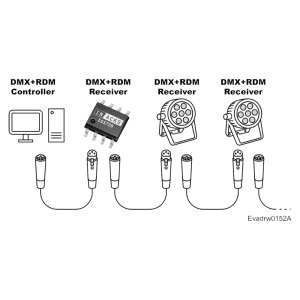
DMX+RDM receiver ICs let a lighting fixture receive DMX512 lighting data and also reply to RDM (Remote Device Management) requests from the lighting controller, the role that the ANSI E1.20 standard calls an RDM responder. With RDM, an operator can discover the fixtures on a DMX line and change settings such as the DMX start address remotely, instead of opening each fixture and setting DIP switches by hand. Supporting both protocols in your own firmware normally means writing timing-critical UART code, interrupt routines and a complete RDM stack for the host microcontroller.
The INACKS DMX+RDM receivers take care of all of that in a dedicated chip. They store all 512 DMX channels in an internal register map that your microcontroller reads over I2C, and they answer RDM requests on their own, so your firmware only reads and writes registers instead of implementing either protocol.
How It Works
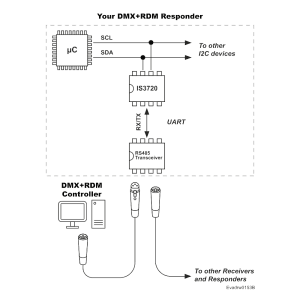
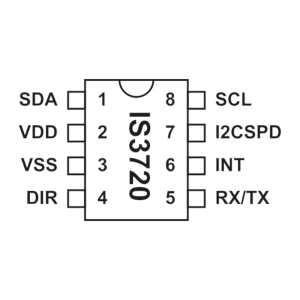
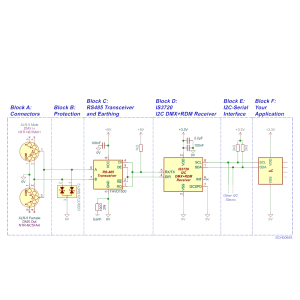
- DMX line side: the chip connects to the DMX+RDM line through its UART pins (RX/TX and DIR) and an external RS-485 transceiver, such as the THVD1500.
- Host side: your microcontroller or single-board computer (for example an Arduino, an STM32 Nucleo board or a Raspberry Pi) communicates with the chip over I2C at 100 kHz, 400 kHz or 1 MHz. The chip runs from 3.3 V and its I2C and UART pins are 5 V tolerant, so it works with both 3.3 V and 5 V microcontrollers.
- Register map: registers 1 to 512 hold the DMX channel values. The RDM parameters, such as the DMX start address and the manufacturer, model and software labels, are mapped after them.
- RDM support: all the PIDs that ANSI E1.20-2010 lists as required are implemented, including discovery, DEVICE_INFO, DMX_START_ADDRESS and IDENTIFY_DEVICE, as well as DEVICE_MODEL_DESCRIPTION and MANUFACTURER_LABEL. An interrupt pin tells the host when the DMX start address or the identify state changes.
Why Use a Dedicated DMX+RDM Receiver?
- Faster development: no DMX timing, RDM discovery or PID handling to write and debug in your firmware, so your product reaches the market sooner.
- Lower load on the host: fewer interrupt routines, lower CPU and memory use, and no dedicated UART or timers needed on your microcontroller.
- Your brand on the RDM controller: you write your company name, model and software labels over I2C, so the fixture shows up under your own names while the chip itself stays transparent.
- Ready for production: RDM parameters are kept in non-volatile memory, and UIDs are easy to program in volume production.
Typical applications include DMX+RDM lighting fixtures, architectural and façade lighting with many fixtures, custom DMX+RDM devices, and fixtures that are hard to reach once installed, such as lights built into pavements, swimming pools or fountains, where changing the DMX address by hand would mean opening a sealed housing.
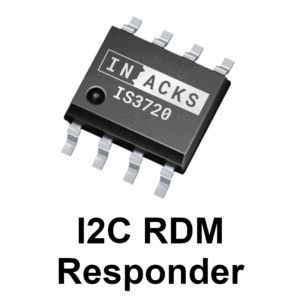
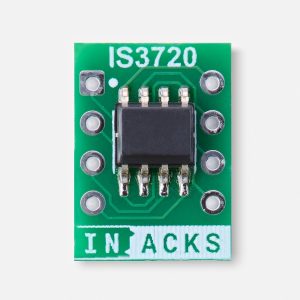
This category includes the IS3720 I2C DMX+RDM receiver chip, available as a bare SO8N chip or pre-mounted on a PCB, and two evaluation boards for trying it without soldering or building a prototype: the Kappa3720Ard, an Arduino-format shield that also fits STM32 Nucleo boards, and the Kappa3720Rasp for Raspberry Pi. Both boards include two daisy-chained XLR-3 DMX connectors and an RGB LED that simulates a DMX PAR light.
Other Lighting Protocol Chips
Addressable LED Controller | DMX512 Controller | DMX512 Receiver | DMX+RDM Controller | Art-Net Controller | Art-Net Receiver