

MQTT: The Standard for Lightweight IoT Communication
MQTT (Message Queuing Telemetry Transport) is the OASIS and ISO standard messaging protocol for the Internet of Things (IoT) and Industrial IoT (IIoT). Designed to be extremely lightweight, it utilizes a publish/subscribe model that decouples data producers (publishers) from data consumers (subscribers), enabling efficient, scalable, and secure telemetry.
This category focuses on hardware solutions that implement the MQTT protocol stack in dedicated silicon. MQTT is ideal for resource-constrained devices, low-bandwidth, and unreliable network environments due to its minimal overhead (header size as small as 2 bytes) and built-in Quality of Service (QoS) levels (0, 1, and 2), which guarantee message delivery reliability across diverse network conditions. Products here provide the essential link between embedded devices and centralized MQTT Brokers or cloud IoT platforms.
Dedicated MQTT Protocol Chips for Rapid Integration
Implementing a full-featured MQTT client, including session management, QoS handling, TLS/SSL encryption, and the underlying network stack (like Ethernet or Wi-Fi), consumes significant flash memory, RAM, and processing cycles on the host microcontroller. This complexity increases development time and firmware cost.
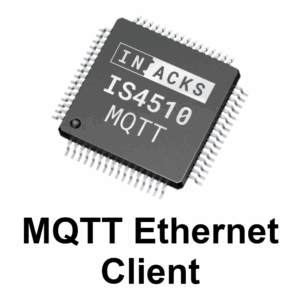
INACKS integrated circuits and modules, such as our MQTT Ethernet Client Chip, solve this critical embedded challenge. By integrating the complete MQTT stack and networking layer into a single chip, INACKS integrated circuits and modules help a lot to develop products with this category because it avoids the firmware engineer to have to implement by itself the protocol. The host MCU simply connects via a low-pin-count interface like I2C, sending high-level publish/subscribe commands. This abstraction provides reliable IoT connectivity out of the box, resulting in less costs for specialized firmware engineers and allowing the final product to be completed sooner.
Key Problems Solved by Dedicated MQTT Chips:
Resource Management: Offloading the MQTT and TLS stack to free up memory and CPU resources on the main application MCU.
Complexity Reduction: Replacing thousands of lines of code with simple register or I2C commands.
Security: Handling secure connection protocols (TLS/SSL) in hardware for enhanced reliability.
Time-to-Market: Accelerating product release by eliminating months of protocol integration and testing.