
Bridging Complex USB Video Class (UVC) for Embedded AI
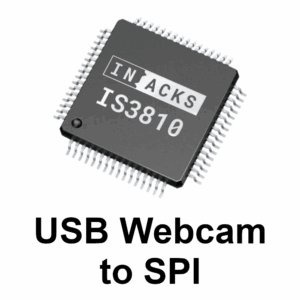
USB Webcam to SPI chips are specialized video bridge controllers that enable standard, low-cost USB Video Class (UVC) cameras to be integrated into resource-constrained microcontrollers (MCUs) and dedicated AI acceleration ICs. The UVC standard demands a complex USB Host stack and significant processing for data synchronization and decompression (MJPEG/YUV), complexities that bottleneck embedded AI processing.
This category features hardware that functions as a crucial protocol and data intermediary. The chip manages the complete USB Host and UVC protocol layers, performing decompression and buffering. This simplified, hardware-managed data path is essential for embedded AI applications where the main processor must dedicate its resources entirely to running image recognition and machine learning (ML) models.
The Essential Data Pipeline for Embedded AI and Feature IA Models
These chips are indispensable for developing advanced embedded AI systems and accelerating machine learning projects. The ability to stream clean, sequential frame data over a simple SPI (Serial Peripheral Interface) allows the host IC—often a dedicated AI processor or an MCU with integrated neural network acceleration—to efficiently ingest data for real-time image recognition, classification, and on-device model training.
By offloading the complex USB Host, UVC protocol, and video decoding overhead, INACKS integrated circuits and modules help a lot to develop products in this category because the hardware allows the main AI-capable IC to focus entirely on feature extraction and running complex IA models. This avoids the firmware engineer to have to implement by itself the protocol, leading to less costs associated with specialized software integration, and ensuring the final product—which leverages sophisticated AI capabilities—can be completed sooner.